

Italian floriculture and nursery sector: growth, production districts and regional specialisations
- News
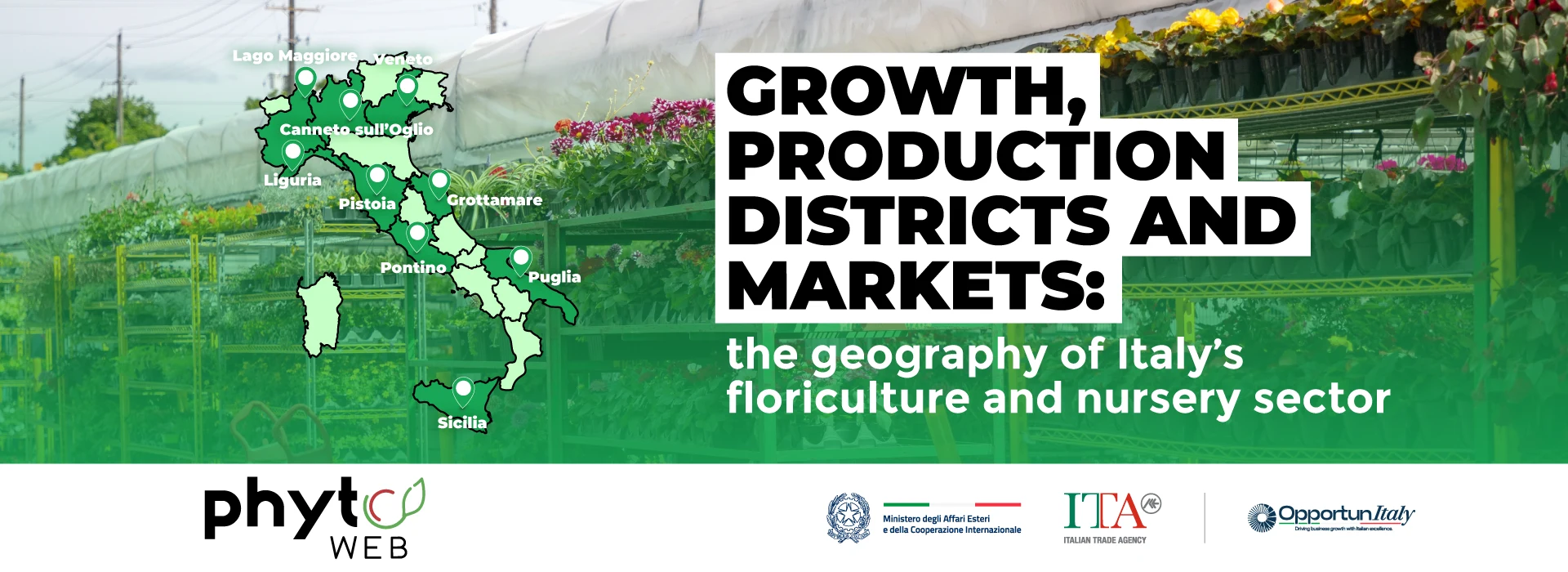
Italy’s floriculture and nursery sector continues to strengthen its role in the national economy, supported by business growth, rising employment and a network of production districts that have developed distinctive expertise and specialisations over time, helping to drive the sector’s competitiveness. Each area contributes to this diverse production landscape, shaping an offering that also reaches international markets.
A growing sector: businesses and employment
According to an analysis by Myplant & Garden, based on data from ISTAT and the Chambers of Commerce, in 2025 Italy’s floriculture and nursery supply chain comprised around 38,000 businesses and more than 84,000 employees. Between 2024 and 2025, the number of businesses increased by 11.8%, while employment grew by 13.6%.
The segments recording the most significant increases included floriculture and retail trade. In the latest year covered by the analysis, the number of businesses in floriculture rose by 7.3%, while employment increased by 20.2%. Retail trade, meanwhile, accounts for more than 18,000 businesses and 24,000 employees. Wholesale trade was the only segment to record a slight decline, both in the number of businesses and in employment.
Overall, the supply chain remains predominantly made up of small businesses, with an average of 2.2 employees per business. Plant nursery production is the most structured segment, with an average of 4.4 employees per business.
The production districts shaping the Italian floriculture and nursery sector
The floriculture and nursery sector accounts for 5% of the value of Italy’s agricultural production and contributes 23% of European floriculture and nursery production. A significant part of this performance is driven by production districts where soil and climate conditions, local traditions, technical expertise and business relationships have fostered the development of specialised production. These areas stand out not only for their concentration of businesses, but also for the wealth of knowledge and resources that has enabled them to establish a strong position in specific market segments.
Pistoia: a leading centre for ornamental plant nurseries
In Tuscany, the Pistoia district is one of Italy’s and Europe’s leading production centres for ornamental nursery plants, with businesses specialising in the cultivation of trees, shrubs and ornamental plants. The district accounts for 25% of the region’s gross agricultural output and represents 5% of European floriculture and nursery production.
The area under nursery cultivation exceeds 5,200 hectares, around 1,000 of which are devoted to container-grown plants. The district is home to 1,500 businesses and more than 5,500 direct employees, while its gross marketable production exceeds €300 million, including €160 million in exports.
Its offering ranges from trees for parks and gardens to ornamental container-grown plants and species used in landscape design. The diversity of its production, together with its well-established focus on international markets, is one of the area’s main strengths.
Liguria: aromatic herbs, cut flowers and foliage
Liguria is a European leader in the large-scale cultivation of aromatic herbs, including sage, rosemary and thyme, as well as a region with a long-standing tradition in floriculture. In the Sanremo area, production is mainly focused on cut flowers and foliage, while in the Albenga area, nurseries specialise primarily in green and flowering container-grown plants.
This range of specialisations reflects the environmental characteristics and production traditions of the region’s different areas.
Canneto sull’Oglio: the ornamental tree district
Between Mantua and Cremona, the Canneto sull’Oglio area has a long-standing specialisation in the cultivation of deciduous ornamental trees and is Italy’s leading producer in this segment. The sector covers approximately 3,000 hectares and comprises around 200 businesses, employing an estimated 1,000 people.
The trees grown in the area are primarily intended for urban green spaces, parks and gardens, alongside a wide selection of other ornamental species. The movement of these plants requires particular attention to phytosanitary considerations, especially for field-grown specimens marketed with their root systems and surrounding soil.
Veneto: ornamental plants for gardens and landscaping
Veneto has a highly fragmented production structure and a marked specialisation in plant nursery production. The historic centre of this activity is the Saonara area, in the province of Padua, one of Italy’s oldest nursery-growing districts. More than 40% of the region’s approximately 2,000 hectares of nursery cultivation are concentrated here, while the region as a whole is home to around 1,000 businesses.
Production includes ornamental garden plants, trees and species used in landscaping and forestry projects. Alongside the local market, businesses also look abroad, with a particularly strong presence in Central European countries.
Lake Maggiore: a tradition of acid-loving plants
The Lake Maggiore area has developed a long-standing tradition of growing acid-loving plants, such as azaleas, rhododendrons and camellias. Today, this specialisation involves around 140 businesses and covers more than 300 hectares, 200 of which are cultivated in open fields.
The distinctive identity of the area’s products and the expertise developed in this sector have also helped businesses expand into international markets, particularly in Northern and Central Europe.
Agro Pontino, Grottammare, Sicily and Puglia: Mediterranean plant production
In Agro Pontino, in the province of Latina, more than 100 floriculture and nursery businesses specialise in Mediterranean plants. The sector employs over 2,000 people and generates an estimated turnover of around €200 million.
In the Marche region, the areas of Grottammare and San Benedetto del Tronto are instead associated with the cultivation of Mediterranean and subtropical plants, including several palm species. The area is home to around 100 ornamental plant nurseries.
In Sicily, production focuses particularly on ornamental citrus plants and species suited to Mediterranean and subtropical climates. The sector comprises around 300 businesses and approximately 1,000 employees, with an estimated turnover of around €200 million. Businesses in the area are working to consolidate and enhance the quality of their production, particularly Mediterranean patio plants such as citrus trees, olive trees, Kentia palms, Phoenix palms and Cytisus.
Puglia also has a strong vocation shaped by its local climate. Its offering includes shrubs typical of Mediterranean scrub, olive trees, subtropical plants and xerophytic species, which are well adapted to high levels of sunlight and limited water availability. With 618 businesses and more than 3,200 employees, the region ranks among Italy’s top ten for floriculture and nursery production and sixth in terms of export value.
From regional specialisations to opportunities in international markets
The network of expertise developed across Italy’s production districts and centres represents an advantage for Italian businesses, which are called upon to meet increasingly diverse international demand with distinctive, differentiated products.
Turning this potential into business opportunities abroad, however, requires a sound understanding of the phytosanitary requirements imposed by destination countries. These requirements may vary depending on the plant species, the type of material being moved, the country of origin and the destination, as well as the presence of specific harmful organisms or particular phytosanitary measures.
This is a concern for the entire supply chain, but it is especially relevant to export-oriented Italian districts, where the range of species traded and the diversity of destination markets can make it more challenging to access phytosanitary information.
Phytoweb: a practical tool supporting businesses
To address this need, ANVE, in collaboration with the Italian Trade Agency, has developed Phytoweb, a free portal dedicated to the floriculture and nursery sector.
The Movement Regulations function allows users to consult phytosanitary requirements based on parameters such as plant species, type of material, country of origin and destination. This enables businesses to identify the relevant provisions before arranging a shipment and plan their commercial activities with greater confidence, reducing the risk of potential issues.
The platform also allows users to generate the Plant Passport and the Plant Passport for Protected Zones in PDF format, ready for printing. These are official documents required for the movement of plants and plant material within the European Union. They certify compliance with the applicable phytosanitary requirements and help ensure the traceability of movements.
The sector’s growth figures and the geography of its production districts paint a picture of a diverse and dynamic Italian floriculture and nursery industry, built on regional specialisations and expertise that contribute to its position in international markets. Making the most of this wealth of resources requires more than high-quality products: businesses must also know how to market them safely and comply with the requirements in force in different countries. In this process, tools such as Phytoweb provide businesses with information and functions that help integrate phytosanitary compliance into day-to-day operations.
The competitiveness of Italy’s floriculture and nursery sector depends on recognising the value of regional specialisations and enabling businesses to turn their expertise into market opportunities, including in international markets.
ULTIME NEWS
Popillia japonica, a challenge for the plant nursery sector: the situation in Italy in 2026
The spread of Popillia japonica in Italy in 2026 poses challenges for the plant nursery sector. Discover affected areas, risks, and movement regulations.
Royalties and new plant varieties: what does it mean to protect innovation?
Before a new selection can be officially recognized and placed on the market, it must meet specific requirements, including distinctness, uniformity, and stability, the criteria assessed in the DUS test.
Ornamental plants, minor uses and innovation: the evolving landscape of plant protection
Protecting ornamental crops requires a balance between the effectiveness of plant protection measures, environmental sustainability, regulatory compliance, and the actual availability of suitable tools.