

Popillia japonica, a challenge for the plant nursery sector: the situation in Italy in 2026
- News
The spread of a harmful organism can have consequences that go far beyond plant health, affecting nursery management, day-to-day business operations and the movement of plants and other plant material. This is what is happening with Popillia japonica, a beetle native to East Asia whose presence in Italy continues to expand.
Classified by the European Union as a priority quarantine pest, it poses a threat to agricultural production, ornamental greenery and natural ecosystems. Monitoring across affected areas, containment measures and compliance with phytosanitary requirements for the movement of plants and plant material are therefore essential to limiting its spread.
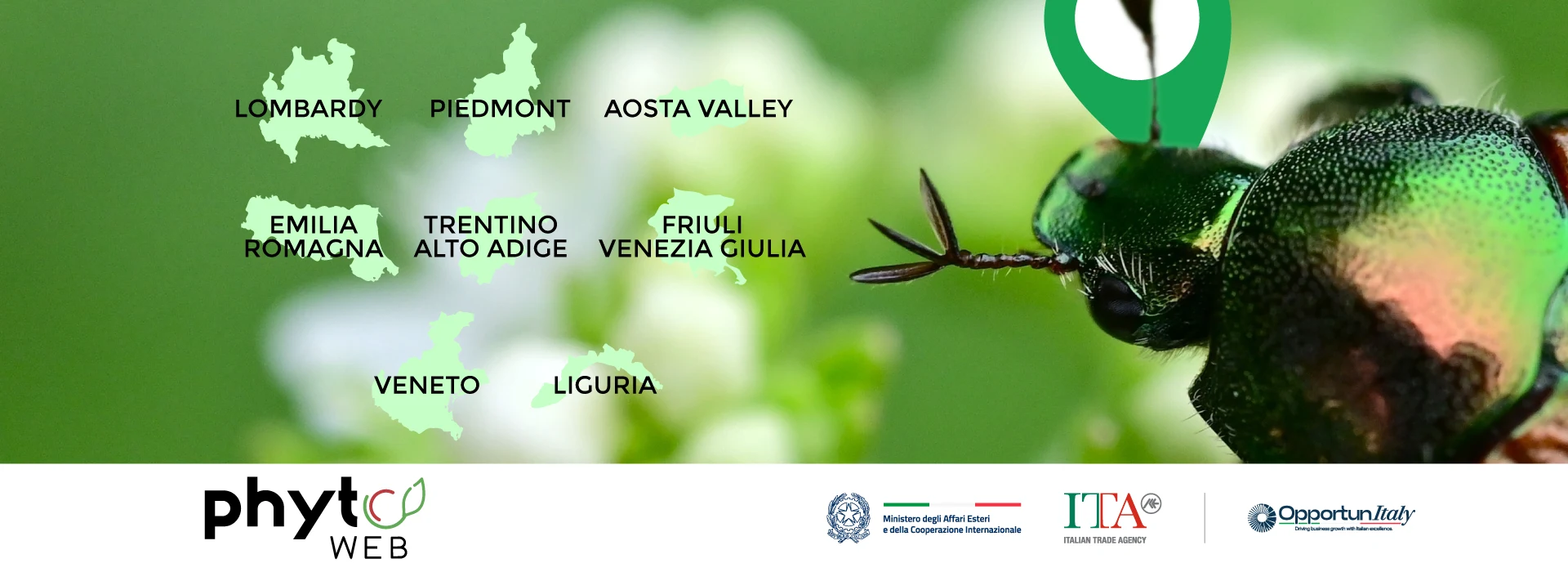
The first detection of Popillia japonica in Italy dates back to 2014, in the area of Parco del Ticino, between Lombardy and Piedmont. Since then, despite surveillance and containment efforts, the beetle’s distribution has gradually expanded, covering an area of more than 40,000 km². The regions now affected are Piedmont, Lombardy, Emilia-Romagna, Aosta Valley, Veneto, Liguria, Trentino-Alto Adige and Friuli-Venezia Giulia.
The situation, however, varies from one area to another. In territories with a long-established infestation, the main objective is to limit further spread, while in areas affected more recently, the priority is to prevent the insect from becoming permanently established.
Lombardy and Piedmont: the original outbreak area
The area of Parco del Ticino remains Italy’s main outbreak area. The extent of the infestation means that complete eradication of the insect within the delimited area is no longer feasible, so efforts are now focused on a long-term containment strategy.
In Lombardy, Popillia japonica is now present across much of the region, with particularly severe infestations in the provinces of Lecco, Como, Monza and Brianza, and Bergamo. The regional Plant Health Service regularly updates maps and trapping data, making it possible to track changes in the insect’s distribution.
Piedmont is also part of the historically affected area, with infestations recorded in several provinces and a particularly high concentration in the Canavese area. Fruit crops are among the hardest hit. According to accounts gathered in 2026, the economic damage estimated by Coldiretti in the area could exceed €10 million.
In both regions, updates to infested areas and buffer zones help determine the surveillance activities and containment measures required.
Aosta Valley and Emilia-Romagna: the spread continues
Following the first findings in 2022, Popillia japonica has become established in the the lower and middle parts of the Aosta Valley, with signs of further expansion into new areas. The regional Plant Health Service has established infested zones and buffer zones extending up to 15 km from their boundaries. It has also deployed mass-trapping devices along the stretch between the two outbreak areas.
In Emilia-Romagna, following the first report in 2021, monitoring has revealed an increase in adult beetle captures and the detection of larvae in already affected areas. Detections recorded in 2025, including within the buffer zone, confirmed that the infestation was continuing to spread. In 2026, the regional authorities therefore expanded the demarcated area and the buffer zone, adding municipalities in the provinces of Piacenza and Parma.
Trentino-Alto Adige and Friuli-Venezia Giulia: preventing establishment
In Trentino-Alto Adige and much of Friuli-Venezia Giulia, the priority is to prevent the beetle from becoming permanently established.
Trentino-Alto Adige is particularly exposed because of its proximity to already infested areas and the risk of accidental transport of beetles. The first interceptions were concentrated mainly along the A22 motorway, but the recent discovery of an outbreak in the municipality of Villa Lagarina has made it necessary to demarcate the area, establish a buffer zone and introduce urgent phytosanitary measures.
In Friuli-Venezia Giulia, the first finding dates back to 2023, in the municipality of Lignano Sabbiadoro. The affected area has been demarcated and placed under emergency measures aimed at eradication, while the rest of the region is still considered pest-free. Within the infested area, agronomic and phytosanitary measures are planned to limit the beetle’s breeding.
Veneto and Liguria: new outbreaks under surveillance
Veneto, initially affected mainly by isolated interceptions, has also recorded new outbreaks that have required the establishment of demarcated areas. The outbreaks identified are located in Riese Pio X, in the province of Treviso; in the Verona area, between Sommacampagna and Villafranca di Verona; and in Brentino Belluno, near the border with Trentino. A buffer zone has also been established in the municipality of San Michele al Tagliamento.
In these areas, control activities include mass-trapping devices, visual inspections of host plants, measures targeting larvae in the soil and biological control measures using entomopathogenic nematodes. The situation is currently considered under control.
In Liguria, the beetle’s presence remains more localised. The main outbreaks are concentrated in the area around Albisola Marina and neighbouring areas, as well as in the Celle Ligure area, where the microclimate and vegetation favour the insect’s development. The regional Plant Health Service has demarcated an infested zone and a large buffer zone, with measures in place to control the pest. Monitoring activities, however, are continuing. In 2026, new detections were reported in several municipalities in the provinces of Savona and Genoa.
The risks for the ornamental plant nursery industry
One of the most challenging aspects of Popillia japonica is its highly polyphagous nature: adult beetles feed on more than 300 plant species, including ornamental, fruit and forest plants, while the larvae develop in the soil and mainly attack the roots of herbaceous plants and grasses. Damage may manifest as skeletonised leaves, damaged flowers and fruit, severe or even complete defoliation and, in cases of larval infestation, yellowing and drying out of lawns.
For nurseries, the risk is not limited to the presence of adult beetles on plants. Eggs, larvae and pupae can also be transported in soil, for example in the growing media associated with root-balled plants, planting stock and turf. Another route of spread is the accidental transport of adult beetles by vehicles and other means of transport.
Prevention must therefore take the entire nursery environment into account: from host plants and turfgrass to materials being moved and logistical flows that could contribute to the pest’s spread.
Movement of plants and plant material: what businesses need to consider
The presence of Popillia japonica entails the application of European, national and regional phytosanitary measures. Affected areas are demarcated on the basis of official findings and may include an infested zone and a buffer zone, each subject to different requirements.
Professional operators should therefore check the applicable obligations before moving or dispatching plants and other plant material. Depending on the area of origin and the type of material involved, requirements may include official inspections, in-house checks, activity records and specific conditions for movement.
There is therefore no single rule that applies throughout Italy: requirements depend on the official demarcation of affected areas and on the latest provisions issued by the competent Plant Health Service. For businesses supplying other regions or exporting abroad, checking these requirements in advance makes it possible to organise the necessary inspections and documentation, reducing the risk of delays and compliance issues.
From risk management to practical tools: the role of Phytoweb
To address the challenges posed by harmful organisms such as Popillia japonica, ornamental plant nursery businesses need easily accessible information and practical tools to support operational decisions, particularly when planning a shipment. This is where Phytoweb comes in: a free portal developed by ANVE in collaboration with the Italian Trade Agency to help operators manage phytosanitary requirements.
Through the “Movement Regulations” function, users can consult the applicable provisions according to plant species, material, country of origin and destination, identifying the requirements to be checked and the rules governing the movement of plants and plant material.
The platform also provides a tool for assessing risks associated with harmful organisms. Users can select their business site, the plant species and the pest to be assessed. The system evaluates the likelihood of exposure to the pest and the severity of potential damage, classifying the risk as low, medium or high. In the case of Popillia japonica, this function can help businesses identify the most critical aspects of their operations and the situations requiring particular attention.
The spread of Popillia japonica in Italy highlights the importance of combining monitoring across affected areas with careful management of nursery operations. Recognising symptoms, checking plants and potentially affected materials, and understanding the applicable requirements are all complementary elements of the same prevention strategy.
In a sector where the movement of plants and plant material is an integral part of commercial activity, phytosanitary knowledge contributes to competitiveness. Protecting plant production means safeguarding the continuity of trade and the reliability of the entire Italian plant nursery industry.
ULTIME NEWS
Italian floriculture and nursery sector: growth, production districts and regional specialisations
Italy’s floriculture and nursery sector continues to strengthen its role in the national economy, supported by business growth, rising employment and a network of production districts.
Royalties and new plant varieties: what does it mean to protect innovation?
Before a new selection can be officially recognized and placed on the market, it must meet specific requirements, including distinctness, uniformity, and stability, the criteria assessed in the DUS test.
Ornamental plants, minor uses and innovation: the evolving landscape of plant protection
Protecting ornamental crops requires a balance between the effectiveness of plant protection measures, environmental sustainability, regulatory compliance, and the actual availability of suitable tools.