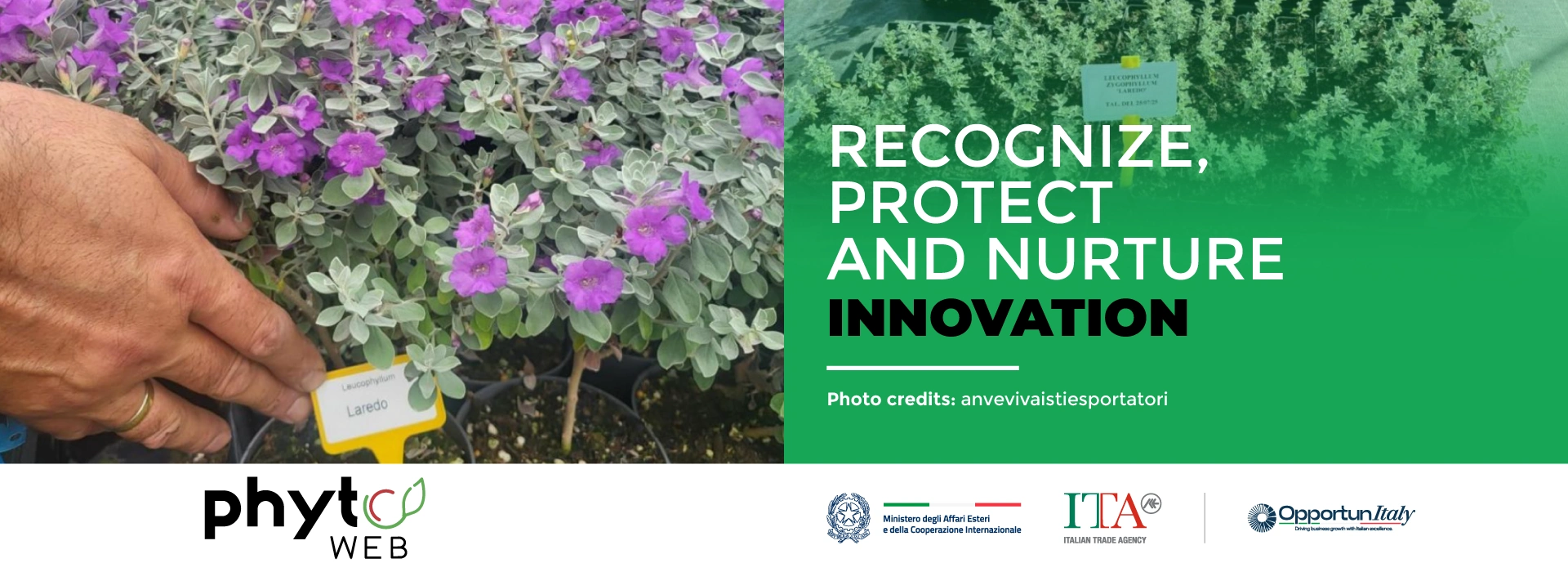
In the ornamental plant industry, innovation also depends on the ability to develop varieties that respond to changing market conditions and evolving production needs. New colours and forms, greater adaptability, and improved resistance to specific environmental conditions: behind every new variety lies a research process that can take years of selection, crossing, testing, and investment.
Not every variety makes it to market. Before a new selection can be officially recognized and placed on the market, it must meet specific requirements, including distinctness, uniformity, and stability, the criteria assessed in the DUS test. A variety must therefore be clearly distinguishable from other existing varieties, display sufficiently uniform characteristics across its plants, and retain those characteristics through successive generations.
This process is precisely what makes intellectual property protection so important to the industry. Plant variety protection provides legal protection for new varieties and recognizes the work involved in developing them, while also creating the economic conditions needed to continue investing in research.
Royalties: the value of research across the value chain
This is where royalties come into play: the fees payable under licensing agreements for the use of a protected variety.
Their significance goes beyond being simply a cost incurred by plant propagators. Through royalties, part of the value generated by the commercialization of a variety is returned to those who developed it and hold the relevant rights, helping to fund new breeding programmes.
The value chain involves several stakeholders: from the breeder, who develops the variety and holds the plant variety right, to the licensee, who pays the royalty and is authorized to propagate it, and the distributor, who supplies it to the public or to other plant nurseries, through to the end customers. Proper management of rights and licences therefore becomes an integral part of how this value chain operates.
Plant variety right, denomination, trademark: terms that should not be confused
When discussing new plant varieties, certain terms are often used interchangeably even though they refer to different forms of protection and identification.
A plant variety right is the specific form of protection granted to a new plant variety. It gives the holder exclusive rights over its production and propagation for the period established by law. A patent, by contrast, protects a technical invention with an industrial application. The two forms of protection may overlap in the plant sector, particularly in the field of biotechnological innovation, but they are not equivalent.
The variety denomination serves a different purpose: it is mandatory and officially identifies the variety, continuing to do so even after the plant variety right expires. A trademark, on the other hand, serves to distinguish a product or the entity responsible for placing it on the market and can be maintained over time.
In short: the plant variety right protects the variety, the denomination identifies it, and the trademark distinguishes it on the market. Understanding this distinction is important for anyone who purchases, propagates, or commercializes plant material.
How is a new variety protected?
Protecting a new variety involves a procedure that can take several years. From submitting the application and technical documentation to the checks required to verify that the variety meets the relevant requirements, including the DUS test, the process involves several stages. Once the required examinations have been successfully completed, the competent authority issues a grant decision. From that point, the variety is officially registered and, following publication, can be lawfully commercialized.
For operators in the ornamental plant sector, the European route is generally preferred to the national one, as a single application provides protection across all 27 EU Member States, giving access to a market of approximately 450 million consumers, as well as a longer protection period: 25 years compared with 20 years for an Italian plant variety right.
Innovation crosses borders: the role of traceability
The management of protected varieties becomes even more complex when plant material crosses national borders. Propagation, movement, and commercialization must comply with the applicable requirements, making identification, documentation, and traceability essential.
In this context, digital tools can simplify operators’ work. Among the features available on Phytoweb, the platform developed by ANVE in collaboration with the Italian Trade Agency, is the ability to download a digital version of the plant passport, the mandatory label for the movement of plants and plant material within the European Union, ensuring proper traceability.
Investing today in tomorrow’s varieties
For the ornamental plant industry, talking about royalties means talking about research, competitiveness, and the future of the value chain.
In a sector facing climate change, evolving production needs, and increasingly specific market demands, developing innovative varieties means creating new opportunities. And creating the conditions that allow those who invest in plant breeding research to continue doing so ultimately means fueling the same innovation process from which the industry derives its value.